
Keep access, clinical flow, and revenue performance working as one operation.
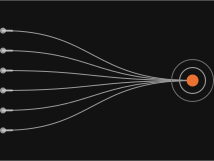
You manage daily performance where scheduling, authorization, documentation, coding, billing, patient communication, and staffing meet. We help you stabilize the workflows that protect patient access, provider capacity, clean claims, and cash across practices, ambulatory sites, imaging, laboratory, and other diagnostic services.
7 of top 20
U.S. health systems served
32M+
Coding charts processed annually
28M+
A/R claims managed annually
Your revenue cycle runs inside the care operation, not beside it.
Practice Administrators, Ambulatory Leaders, and Diagnostics Managers balance patient access, provider schedules, staffing, throughput, service quality, and financial performance. A missing referral, authorization delay, incomplete order, registration defect, documentation gap, coding backlog, or billing issue can disrupt both care flow and revenue. When each function manages its own queue, your teams spend time chasing handoffs instead of keeping patients and accounts moving.
Protect the schedule before service
Keep encounters claim-ready
Cash steady enough to plan a practice around
The whole billing job, or just the parts that hurt.
Front-office, mid-office, and back-office revenue cycle support can be scoped by practice, location, modality, specialty, payer, service line, queue, or backlog. Each delivery area fits into your operating model with agreed ownership, service levels, escalation, and visibility.
Front-office
Access and readiness - fewer scheduling, referral, coverage, authorization, registration, and patient-financial gaps.
- Scheduling and Registration
- Patient Access Management
- Eligibility and Benefits Verification
- Registration QA and Demographic Accuracy
- Prior Authorization
- Insurance Discovery and Coverage Discovery
- Price Transparency and Patient Estimates
- Financial Clearance and Counseling
- Referral Intake
- Patient Communication
Mid-office
Encounter and claim integrity - complete documentation, accurate coding, supported charges, and compliant billing.
- Medical Coding
- Coding Audits and Quality Assurance
- Clinical Documentation Integrity (CDI)
- Clinical Abstraction
- Charge Capture Optimization
- Revenue Integrity and Leakage Prevention
- Billing Compliance and Audit Defense
- Health Information Management Support
Back-office
Payment and resolution - faster movement across claims, payments, denials, underpayments, patient balances, and A/R.
- Claims Editing and Clean-Claim Validation
- Claim Submission and Clearinghouse Support
- Payment Posting and Reconciliation
- Accounts Receivable Follow-Up
- Denials Management and Appeals
- Underpayment Recovery and Payer Variance Resolution
- Self-Pay, Charity Care and Medicaid Screening
Four things a well-run practice can finally stop worrying about.
Complete billing
Charge Capture Optimization · Insurance Discovery and Coverage Discovery - so every visit, scan, and test becomes a complete claim, with coverage found even when cards are missing.
Predictable deposits
Claims Editing and Clean-Claim Validation · Accounts Receivable Follow-Up - so cash arrives on a rhythm you can staff, buy, and plan against, month after month.
Patient goodwill
Price Transparency and Patient Estimates · Patient Communication - so estimates come before care, statements make sense after, and billing calls end in thank-yous more often.
Provider confidence
Computer-Assisted and AI-Enabled Coding · Medical Coding - so physicians see comp numbers built on audited coding, and the paycheck conversation gets shorter.
One operating model. Three pillars. Every engagement.
Expertise-led
Revenue cycle specialists work inside the practice, ambulatory, and diagnostic workflows they support.
- Expertise across access, authorizations, coding, billing, denials, payments, and A/R
- A named engagement lead connecting daily work to site priorities
- Capacity aligned to schedules, modality, specialty, volume, backlog, and exception risk
Technology-powered
Technology-enabled services make site work more consistent, prioritized, visible, and auditable.
- Queues prioritized by appointment, service date, payer, aging, financial risk, and next action
- Rules and automation for repeatable validation, routing, status, reconciliation, and follow-up
- Dashboards connecting volume, readiness, quality, turnaround, exceptions, and outcomes
Operationally-governed
Governance connects site performance to ownership, escalation, and corrective action.
- Agreed service levels, KPI definitions, baselines, targets, data sources, and cadence
- Root-cause review by location, specialty, modality, payer, provider, workflow, and denial cause
- Closed-loop action carrying findings back to scheduling, access, documentation, coding, and billing
Our Vision
Open Accountability: Taking responsibility without taking control.
Practice leaders get sold billing magic and handed billing mystery. This stays legible: commitments written down, your data, your definitions, plain-language reporting, and scope you resize as the practice evolves, whether the work runs on your systems or through RevAmp. Misses get explained in person, and staying is a decision you re-make monthly.

Collections per visit
Average payment realized for each completed visit
Unbilled visits
Encounters waiting on notes, charges, or fixes
Time to payment
Days from the visit to money in the bank
Denials explained
Denials categorized in plain language, with fixes
Patient collections
Patient-owed dollars collected after the visit
Why Us
You can buy billing help anywhere. Buying certainty is harder.
A practice absorbs billing mistakes twice: once in the write-off, again in the evening you spend untangling it. Our First-Pass Performance exists to give you both back.
Rework-Powered Cleanup Machine
Our First-Pass Performance
Schedule readiness
Missing requirements surface near or after the appointment.
Coverage, referrals, authorization, registration, and financial steps are visible early enough to act.
Encounter completion
Orders, documentation, coding, and charges move through separate queues.
Clear completion rules connect the encounter to claim-ready status.
Capacity
Staff respond to whichever queue is loudest while priority and risk remain unclear.
Work is prioritized by service date, patient impact, financial risk, aging, and next action.
Technology
Point tools add alerts and manual reconciliation around the core workflow.
Technology supports defined work, users, exceptions, controls, and measurable outcomes.
Accountability
Sites and vendors report activity while outcome ownership stays unclear.
Agreed work has a named owner, shared measures, cadence, and visible corrective action.
Extend performance across connected outcomes.



Revenue cycle thinking for leaders who need fewer surprises.
Explore Vee Healthtek perspectives on the forces reshaping revenue cycle performance, healthcare operations, technology adoption, and financial resilience.



Show us one month of your billing. We will tell you what it says.
Schedule a 30-minute conversation with our practice billing leadership. Bring last month's report from your current setup, or just your questions. We will translate what the numbers mean, flag what looks off, and outline what practice-sized support would ask of your team.
Frequently Asked Questions
How can revenue cycle support fit into a practice, ambulatory, or diagnostic operation?

Which front-office, mid-office, and back-office functions can you support?
How do you help reduce authorization and referral delays?
How do you improve coding and billing turnaround across sites?
How do you support diagnostic services such as imaging and laboratory?
How do you use automation in ambulatory revenue cycle workflows?
Which KPIs can we govern together?
What should you bring to an initial working session?