
Insurance Discovery and Coverage for cleaner coverage capture.
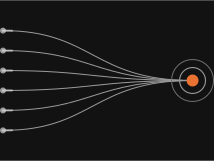
Insurance discovery and coverage sit where missing insurance, inactive coverage, self-pay risk, secondary payer opportunities, and stale patient data create avoidable revenue leakage. We help provider organizations identify active coverage, validate payer information, search for hidden or alternate coverage, update records, and route exceptions before claims, denials, collections, or patient statements absorb preventable rework.
Front-office
Revenue cycle service
Payer databases
Coverage search and validation
QA-led
Coverage accuracy and record updates
Coverage discovery that protects cash, collections, and patient clarity.
Insurance discovery and coverage services help hospitals, physician enterprises, emergency departments, ambulatory sites, outpatient programs, and specialty groups identify active or alternate coverage when records are incomplete, inaccurate, inactive, or marked self-pay. The work reduces avoidable risk across missing payer data, coordination of benefits, Medicaid or commercial coverage changes, secondary payer opportunity, charity or self-pay routing, eligibility denials, patient statement friction, A/R aging, and handoffs into billing, collections, and denials.
Find billable coverage earlier
Reduce self-pay leakage
Protect claims from payer-data defects
Search, verify, update, route, and govern. Coverage discovery built for first-pass revenue cycle performance.
The program is organized around the work that determines whether a patient account has the right coverage attached before revenue moves to self-pay, billing, collections, or denials. Each workstream connects patient demographics, payer search sources, eligibility results, coordination logic, record updates, exception queues, and quality review into one accountable coverage model.
Identify missing or inactive coverage early
Demographic screening and payer search workflows - fewer self-pay misroutes and missed billable coverage opportunities.
Validate discovered payer information before billing
Eligibility checks, plan matching, and subscriber review - reduced claim rejections, payer-data defects, and coverage disputes.
Search for secondary, alternate, and retroactive coverage
Coverage discovery logic and exception queues - more complete payer sequencing and lower underpayment or write-off risk.
Update patient accounting records with auditable evidence
Structured record updates and documentation trails - cleaner handoffs into billing, denials, collections, and patient financial services.
Govern discovery quality with visible controls
QA sampling, defect trends, and root-cause review - stronger accountability for hit rate, accuracy, aging, and downstream rework prevention.
Cleaner coverage capture. Fewer self-pay misses. Stronger claim readiness.
Reduce leakage from missed or stale coverage
Coverage search, eligibility validation, and account updates help teams identify billable coverage before balances move too far into self-pay or write-off paths.
Improve payer sequencing and claim readiness
COB review, subscriber matching, and plan validation reduce incorrect payer order, claim rejections, and avoidable billing corrections.
Lower patient financial friction
Accurate payer discovery helps avoid premature patient billing, repeated outreach, surprise balances, and confusion when coverage exists but was not attached.
Give leaders visibility into discovery yield and aging
Dashboards and governance reviews track search inventory, hit rate, validation accuracy, pending items, account updates, and downstream denial or collection impact.
One operating model. Three pillars. Every engagement.
Expertise-led
Coverage discovery specialists who understand payer search sources, demographics, eligibility results, COB logic, patient accounting records, and access handoffs.
- Coverage discovery specialists trained on demographic matching, payer search tools, eligibility responses, COB indicators, and client-specific update rules
- Pod leads coordinate high-risk self-pay, uninsured, inactive coverage, secondary payer, and aged discovery queues
- QA reviewers turn coverage defects into coaching, work instructions, and workflow fixes
Technology-powered
RevAmp-supported workflows, automation-enabled checks, queue visibility, and coverage analytics help teams find, validate, and update coverage faster.
- EHR, EMR, patient accounting, eligibility, payer portal, clearinghouse, and discovery workflows remain the system of record
- Automation-enabled checks support patient matching, coverage search, plan validation, duplicate review, COB cues, and exception prioritization
- Dashboards track discovery volume, hit rate, validation accuracy, account updates, queue aging, QA trends, and productivity
Operationally-governed
Named ownership, QA cadence, exception controls, and dashboard reviews keep discovery work measurable instead of buried in self-pay or billing volume.
- Daily production controls keep self-pay, inactive coverage, secondary payer, and pending validation queues moving
- Weekly operating reviews align search yield, payer behavior, backlog, quality, aging, and downstream denial or collection risk
- Closed-loop CAPA feeds recurring defects back into scripts, matching rules, payer logic, and access workflow updates
Our Vision
Open Accountability: Taking responsibility without taking control.
Insurance discovery and coverage should not require leaders to give up control of patient accounting rules, self-pay strategy, payer update standards, or patient communication. You keep visibility into queues, search logic, account updates, and downstream priorities. The service owns the outcomes it commits to through modular support, co-managed operations, or end-to-end execution, with transparent reporting built around the metrics that determine coverage capture and leakage prevention.
Coverage hit rate
Billable coverage identified
Validation accuracy
Discovered payer data confirmed
Account update turnaround
Coverage attached before billing
Self-pay conversion
Balances moved to payer path
Downstream denial rate
Coverage defects prevented
Why Us
What sets our insurance discovery and coverage approach apart.
Coverage discovery breaks down when missing insurance, stale demographics, inactive plans, and secondary payer opportunities sit inside self-pay or denial queues for too long. The model turns coverage rework into first-pass performance by making discovery, validation, account updates, and exception aging visible earlier.
Rework-Powered Cleanup Machine
Our First-Pass Performance
Discovery timing
Coverage is searched after balances already age in self-pay or denials
Coverage search starts early enough to redirect accounts before leakage compounds
Data quality
Incomplete demographics and subscriber details limit search accuracy
Patient and payer fields are validated before account updates move downstream
Payer sequencing
Secondary or alternate coverage is missed or attached in the wrong order
COB cues and payer matching improve sequencing before billing decisions harden
Exception handling
Pending matches and unclear results age without ownership
Exception paths route unclear, high-value, and aged accounts to the right next action
Capacity use
Internal teams absorb manual searches, corrections, and patient billing fallout
Practitioner capacity handles defined discovery work while governance tracks yield, accuracy, and aging
Leveraging Agentic AI to Reduce Eligibility Denials by 26%
A Midwest-based outpatient health system with more than 100 clinics faced eligibility denials tied to coverage and registration defects, including incorrect insurance and demographic data. The published case study connects directly to coverage discovery because it shows how root-cause analytics, RevAmp, agentic AI, EDI transactions, and payer communications helped identify high-risk accounts, reduce manual bottlenecks, and improve eligibility denial performance.
26%
Reduction in eligibility denials
$3.6M
Average monthly savings
41%
Productivity boost
Extend performance across connected outcomes.



Revenue cycle thinking for leaders who need fewer surprises.
Explore Vee Healthtek perspectives on the forces reshaping revenue cycle performance, healthcare operations, technology adoption, and financial resilience.

See where missed coverage enters your revenue cycle.
Schedule a 30-minute working session with a coverage discovery operations lead. Bring a sample of self-pay, inactive coverage, eligibility denial, secondary payer, returned statement, and aged claim queues. The team will review where billable coverage is missed, which data defects block discovery, and which controls can reduce leakage before billing, collections, and A/R are affected.
Frequently Asked Questions
What do insurance discovery and coverage services include for healthcare providers?

How does coverage discovery reduce revenue leakage and A/R aging?
Which accounts should be prioritized for insurance discovery?
Can insurance discovery and coverage outsourcing work with in-house teams?
Which KPIs should CFOs and Revenue Cycle leaders track for coverage discovery?
Which EHRs, EMRs, payer portals, and revenue cycle systems can discovery teams support?
Are offshore insurance discovery and coverage services appropriate for U.S. providers?